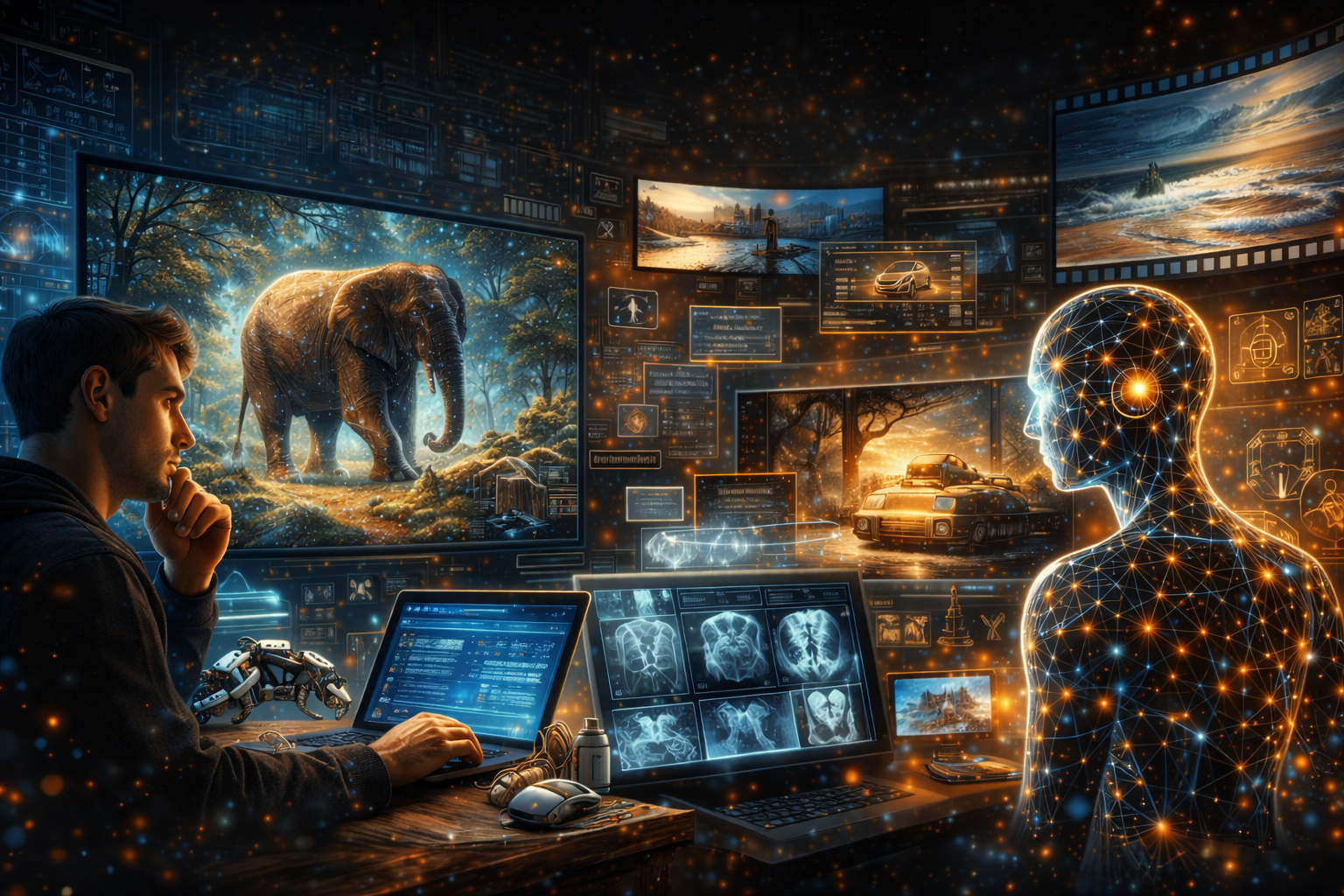
In 2025, artificial intelligence made monumental strides across both reasoning and vision domains, reshaping what is possible in language, code, images, and video.
In Part I, reasoning models became the defining trend of the year, with major labs like OpenAI, Google, Anthropic, and DeepSeek pushing LLMs to think more deeply and accurately via reinforcement learning with verifiable rewards and test-time compute scaling. These reasoning models achieved gold-medal-level performance on benchmarks like the IMO and competitive coding contests, demonstrating that AI can now perform multi-step reasoning tasks that once eluded even advanced systems. Coupling reasoning with tool use gave rise to truly agentic models capable of API interaction, desktop automation, and full coding workflows, exemplified by products such as Claude Code. Research in test-time scaling also challenged traditional assumptions about inference, showing that smaller models with the right strategies can rival much larger counterparts.
Part II highlights how 2025 was also a breakout year for computer vision and generative models, as diffusion training gave way to flow matching and Transformer-based architectures overtook U-Net for image and video generation. Consumer-grade tools like GPT-Image-1.5 and Google’s Nano Banana Pro pushed quality, resolution, and text integration, while Sora 2 and Veo 3 signaled a “ChatGPT moment” for synchronized video with audio. In 3D vision, methods like 3D Gaussian splatting eclipsed NeRF, enabling real-time rendering and interactive scene editing. Foundation models penetrated medical imaging at scale, with hundreds of FDA-cleared AI devices improving diagnostics and workflows. Across both articles, 2025 is shown as the year where theoretical advances, architectural innovations, and practical deployments converged, driving AI from niche research into broad industry impact.
Taken together, these developments suggest that 2026 will see wider adoption of agentic AI, multimodal understanding, and real-world visual AI tools. For deeper insights into these breakthroughs and the detailed technologies behind them, read Part 1 here and Part 2 here
The evolution of data centers towards power efficiency and sustainability is not just a trend but a necessity. By adopting green energy, energy-efficient hardware, and AI technologies, data centers can drastically reduce their energy consumption and environmental impact. As leaders in this field, we are committed to helping our clients achieve these goals, ensuring a sustainable future for the industry.
For more information on how we can help your data center become more energy-efficient and sustainable, contact us today. Our experts are ready to assist you in making the transition towards a greener future.
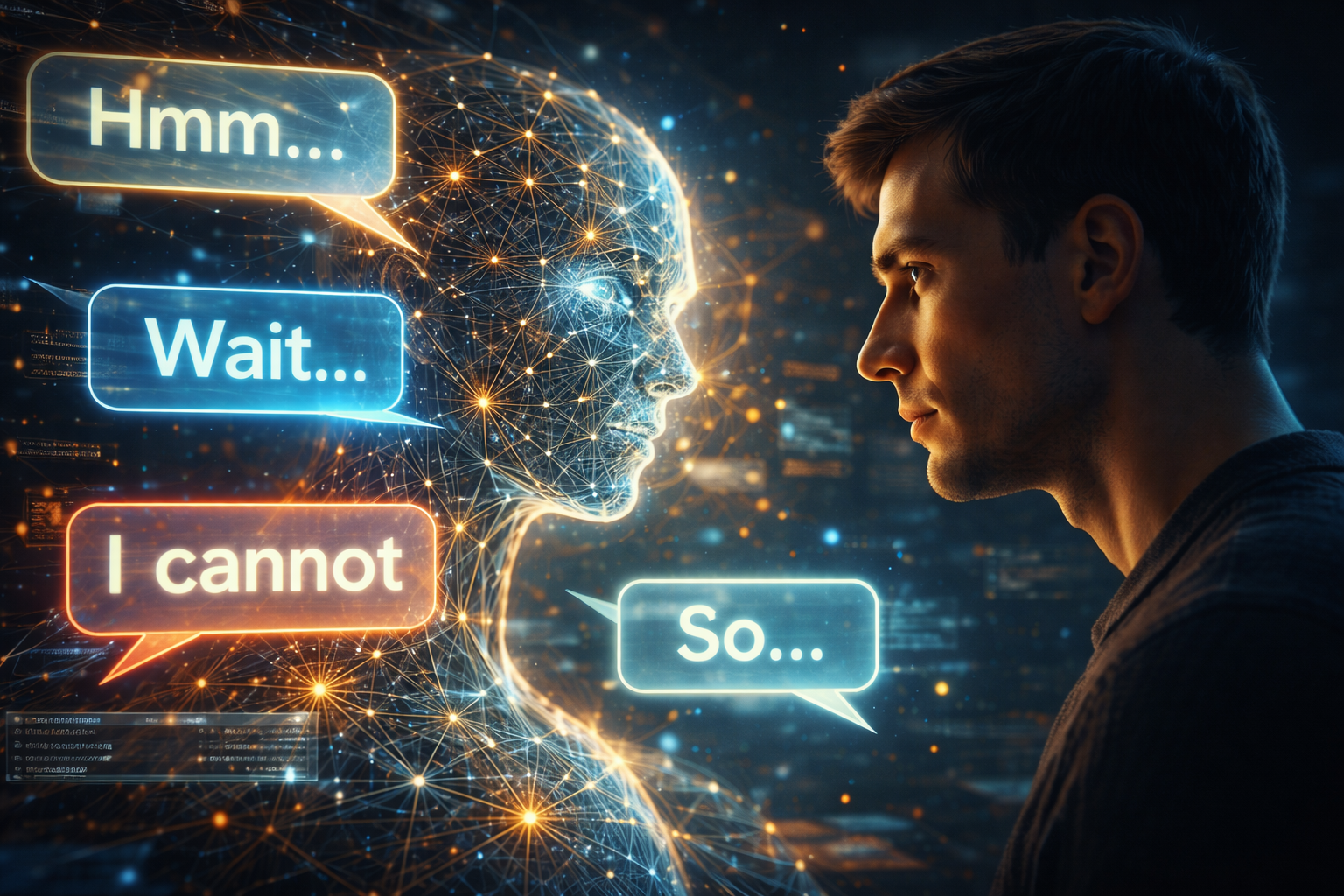
This post explores a surprising discovery in modern reasoning models: seemingly meaningless words like “Hmm,” “Wait,” or “I apologize” often act as control signals that shape how a model thinks, backtracks, or refuses. Drawing on recent research, it shows how these ordinary-looking tokens can function as mode switches - structurally load-bearing elements that influence reasoning quality, test-time compute, and even safety behavior.
Read post


Language models are starting to break free from the limits of word-by-word prediction, stepping into continuous latent spaces where they can plan, reason, and represent meaning more like humans do. This article dives into the breakthrough approaches enabling this shift—from concept-level modeling to latent chain-of-thought. The result is a glimpse at a new generation of AI that thinks before it speaks.
Read post
© 2024 theMind Inc. All rights reserved.


.svg)
.svg)