
Go Back
Published
October 30, 2026

On October 6, 2026, OpenAI released 722 manuscripts resolving 372 families of open mathematical problems. Within a week, over a hundred mathematicians, from graduate students to Fields medallists, had recorded their reactions in public. This post reads all of them, counts them, follows what happened to one of the results during its first two weeks, and asks what the first profession to meet a superhuman AI can tell everyone else.

When OpenAI released several hundred new mathematical results at once on October 6, my honest first reaction was that I did not know how to write about them. Most of these results I cannot follow even at the level of their statements. But this is one of the most important days in the history of mathematics, so I couldn't stay silent. This is a post not about theorems but about people.
A quick recap of how we got here. In May, an OpenAI model disproved the Erdős unit-distance conjecture. In July, GPT 5.6 Sol proved the cycle double cover conjecture, Claude Fable found a counterexample to the Jacobian conjecture, and Dmitry Rybin disproved the Dinitz–Garg–Goemans conjecture in four prompts. In August the avalanche began, and in September the Navier–Stokes Millennium Problem fell. Then came October 6: OpenAI confirmed long-standing rumors and released a mass of new results as preprints.
It it was not part of a global AI revolution, the document modestly titled "OpenAI Research Catalog" would be the mathematical text of the millennium, or maybe two millenia.

Two days later, Proofs and Prompts, a collective blog where mathematicians have been discussing AI since the summer, asked colleagues for short reactions while the wound was fresh, signed by name only. No titles or affiliations necessary: we are all in the same boat here. By October 13 there were 106 reactions, from graduate students to Fields medallists, plus nearly ninety comments. In his detailed overview, Zvi Mowshowitz called the collection an excellent answer to the question of what mathematicians are thinking right now. I would go further: it is a unique historical document. I cannot recall another case of an entire scientific community recording its feelings so openly and publicly within a single week.
I read all 106. Since I wanted to get past the obvious "half are delighted by the new knowledge, half are afraid of losing their jobs" (spoiler: surprisingly few write about their own jobs), I tried to annotate and count them, with the help of, as Levent Alpöge famously put it, "my close friend Fable".
We will start with what happened, then view the numbers, then the main storylines, what happened to one of the results in its first two weeks, what changed in the second week, and, finally, what the whole episode tells those of us outside research mathematics.

On October 6, OpenAI put 722 manuscripts on GitHub, grouped into 372 "result families": a main result plus companion papers, corollaries, and alternative proofs. All were obtained by the same internal model (apparently the one that solved Navier–Stokes), almost all by the same procedure: the model was offered roughly 4,000 open problems, and each result took on average about as much compute as three hours of ChatGPT Pro thinking. Lean formalizations accompanied just under half of the main results (300 of 719, and growing). For ten results, condensed accounts of the model's reasoning were published.

Practically every one of these results is genuinely important. A few highlights:
Scott Aaronson pointed out that 372 papers with new important results out of 4,000 attempts is roughly a 10% success rate: ten percent, on problems that entire communities had been thinking about for years, after a single three-hour attempt each. In August, ten solved problems from the same OpenAI looked like a sensation. Now, we have hundreds in a single release, including dozens of problems from any possible list of top open problems in all of mathematics. There is no full Riemann hypothesis in there, and, suspiciously, no cryptography at all, although theoretical computer science is a large section; we will return to this.
How it was released. After the Navier–Stokes scandal, OpenAI approached several prominent mathematicians, who assembled an independent Advisory Group on Mathematics and Artificial Intelligence (AGMAI) at the Institute for Advanced Study: Timothy Gowers, Edward Witten, Martin Hairer, Ulrike Tillmann, Ravi Vakil, Melanie Matchett Wood, and others. On September 29, AGMAI published recommendations on how labs should responsibly release AI mathematics.
The first paragraph asks labs to stop testing closed internal models on serious open problems altogether. If that doesn't work, then come the requests: cite related work; rewrite proofs as normal mathematical papers (at least with the same LLMs); use an independent repository with comments; publish prompts, reasoning traces, compute and cost; formalize what can be formalized; report how many problems were tried; and fund human understanding of the results through independent non-profits.
OpenAI followed some of this (fast release, formalizations, ten reasoning summaries, the number of problems, a promise to fund workshops) and ignored the rest: the repository is OpenAI's own with pull requests closed, the texts are mostly very hard to follow, and the README explains outright that open problems are part of model evaluation and came into wider use once existing math benchmarks saturated. AGMAI issued a careful statement the same day: its involvement implies neither an assessment of the results nor an endorsement of the process, and the future of mathematics cannot consist solely of sorting through what AI labs put out.
The morning after. On October 7, OpenAI withdrew three manuscripts: a sign error collapsed a paper on Weil classes and two papers depending on it. All three were from the unformalized part of the catalog; no errors have been found in the Lean formalizations so far. Frank Calegari joked that the sign error is the best evidence to date that the model is conscious.
"The Anthropic way". A day before, on October 5, Josh Alman and Virginia Vassilevska Williams posted a preprint refuting the 3SUM and APSP conjectures, two cornerstones of fine-grained complexity.

In any year before 2026 this would have been the result of the year in theoretical computer science. The key idea was Claude's, and Anthropic, in the spirit of the AGMAI recommendations, paid two leading experts to understand it and write the paper the human way.
Aaronson summarized it as two models of publishing AI mathematics: the "OpenAI model", dump everything and let humans race to figure it out, and the "Anthropic model", where the company itself chooses which humans get to be the AI's envoys. Both have obvious pros and cons.
What became clearer over the next two weeks. "Three hours per result" turned out to mean less than it sounds. An OpenAI representative told Scientific American that almost every result came from one prompt to one agent, but some took several attempts, and the README says some results build on earlier results by the same models.
But, while obviously many of the results are not yet understood by mathematicians, the errors have been very few. Quanta's "Cracks appear in OpenAI's wall of proofs" reports fixable technical problems with several Lean statements, and Johan Commelin of the Mathlib Initiative reminds everyone that whether a formal statement matches what the paper claims has to be checked by humans.
On October 15 the Simons Foundation announced a $15 million program with OpenAI and Anthropic: grants to institutes for workshops that will help mathematicians assess AI results "by the standards of the mathematical community". This is AGMAI's principle in action: the labs should pay for human understanding.
All of which sounds rather positive. Now let us see how the mathematicians took it.
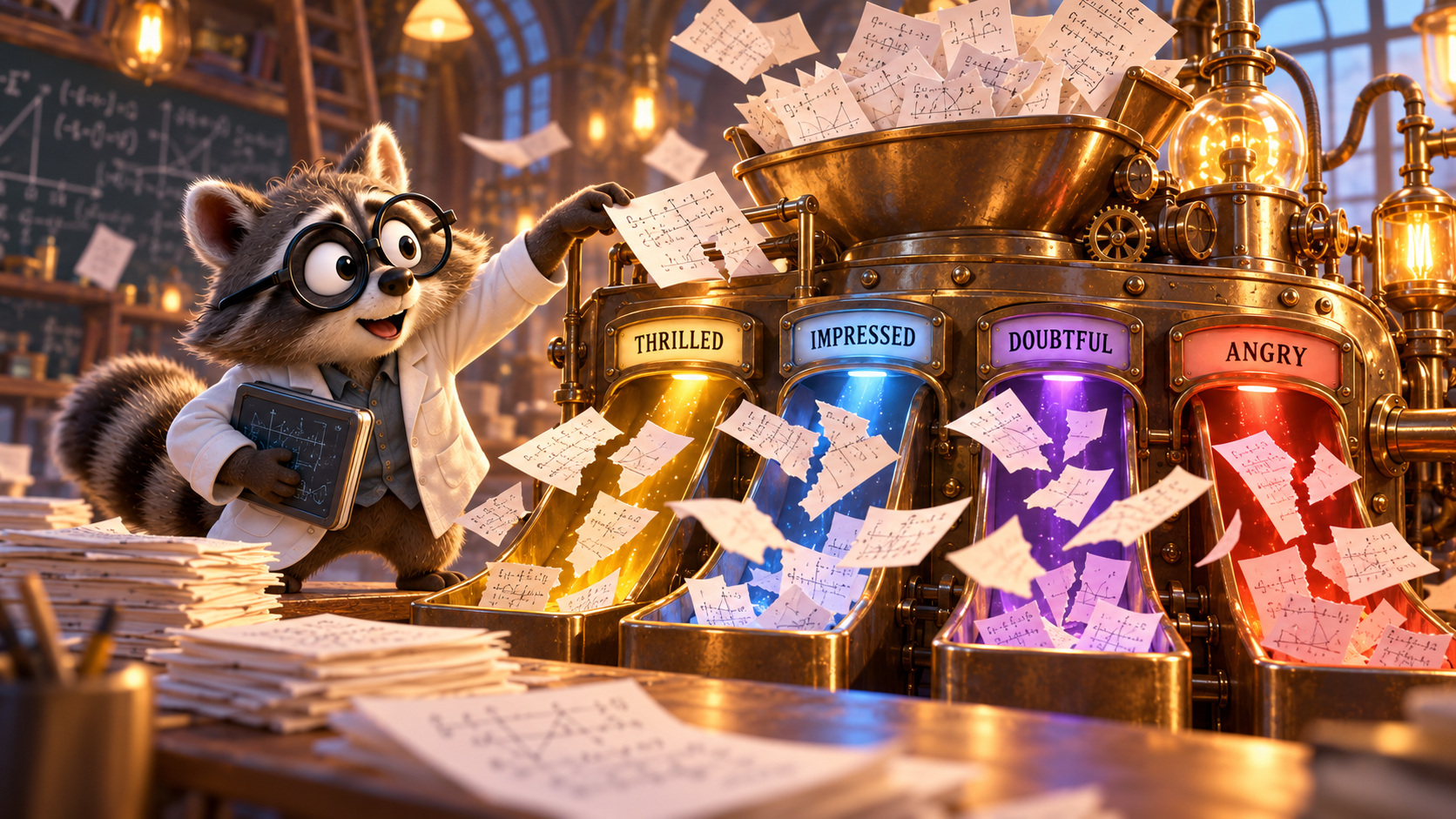
For each of the 106 reactions I (with more than a little bit of help from my friend Claude) recorded the author's attitude to the mathematics itself (thrilled; impressed with caveats; no assessment or ambivalent; doubtful), the attitude to how OpenAI released it (strongly opposed; critical; neutral; approving), the themes touched, and what the author proposes to do.
The coding is subjective, and the sample is not representative (geometric group theorists, topologists, and operator algebraists are heavily overrepresented, and these are the areas the release hit hardest). But the picture is, I think, very telling. Vertical axis is the attitude to the mathematics, horizontal is the attitude to the manner of release, grey bars are the totals.

On the mathematics, near consensus. Of the 62 people who say anything about the results themselves, 56 are impressed, 31 of them outright thrilled. The words repeat from text to text: science fiction, breathtaking, never thought I would live to see it. Six are doubtful, and almost always the doubt is about unreadable texts, not wrong results. Not one of the 106 claims that this is not real mathematics. A year ago, the first LLM-proved results drew mostly that response.
On the manners, near consensus in the opposite direction. Of the 53 who discuss how OpenAI released all this, 49 are critical, 21 of them harshly. Only four approve.
The dividing line is not where people usually look for it. It does not run between believers and unbelievers, or between supporters and opponents of AI. Among the 31 who commented on both the mathematics and the manner of release, 22 are simultaneously impressed and unhappy, and a third of all reactions explicitly combine opposite emotions. Carl-Fredrik Nyberg-Brodda admits that being a mathematician these days is at once anxious, joyful, and an honor; Alon Dogon writes that his feelings changed many times in a single day, from acute fear for the future to delight that his favorite problems finally have answers.
The split begins when it comes to what to do next:

On the right, the community divides into roughly equal camps: dig into the proofs; accept the new reality and adapt; urgently change the institutions (hiring, grants, publishing); and, for a minority, refuse to take part.
The most radical position comes from the new Association for Human Mathematics (about a thousand members), which called the release "a show of force" and urged mathematicians to stop working with OpenAI. One sentence from the statement has gone around social media:
Mathematicians did not ask for this work to be done.
Aaronson's response was to imagine Hardy asking Ramanujan who exactly had asked him to prove all those identities. When Tao reposted the statement on his blog as a guest post, part of the internet decided that he agreed with it, which caused another round of turbulence.
On the left is what people write about. Fear for one's own job, the proverbial "out of a job", is explicit in only a handful of texts: people applying for postdocs, writing grant proposals, or living off teaching. Concern for young colleagues, on the other hand, appears in every fourth reaction. And the top themes are not about money at all: understanding and digesting the results, OpenAI's conduct, the lost journey to the answer, and what a mathematician is now. The main emotion of these texts is not fear of financial loss but loss of meaning.
Having your own problem solved does not determine the reaction. Among the twenty whose own problem or program was "taken", the average assessment of the new mathematics is the same as for everyone else, and they are more likely than the rest to plan to sit down and read the proofs. What does determine the reaction is career stage, as many say themselves: Martin Bridson writes that twenty years ago he would not have been so calm, and Harry Baik that he can afford to keep looking for understanding because he has tenure.

Now to the texts themselves, grouped by the storyline. All quotes without a separate link are from the Proofs and Prompts collection; many are wonderfully written, and I recommend the originals.

Let me start with what hurts most: the people whose problems were on the list.
Matt Zaremsky had spent several years building a program around the Boone–Higman conjecture in group theory, refining with coauthors a sufficient condition for a group to satisfy it, with a serious breakthrough roughly once a year. OpenAI's solution showed that their condition always works, with a missing mechanism very much in the spirit of their own 2025 breakthrough. They were on the right track and would probably have gotten there in another year or two.
So, how does that feel? Well, it feels like we've been working on an archeological dig for 4 years, gradually discovering more and more of a really cool-looking dinosaur skeleton, and then a trillion-dollar company showed up and just blasted the whole thing with TNT, handed us the whole skeleton, and walked away. So, I guess I'd say, "not great".
Tasmin Chu of Caltech works on the Benjamini–Schramm conjecture about percolation on nonamenable graphs, the problem that made Chu fall in love with percolation theory; the grant application due next week will have to be rewritten.
I realize now that what I wanted more than to know that is true was the time and space to think about it for the next few years. I feel a profound sense of grief for the working conditions I believed I would have.
Hugo Duminil-Copin, Fields medallist of 2022, expected humans to be surpassed someday, but not like this:
Not a single one of the major open problems I have publicly mentioned throughout my career (whether in a talk, a lecture, an article, or even a grant proposal) was left untouched by the announcement. Everything has been claimed to be proved. I expected to see a few of them in the list. But not all of them. Not all at once. Not with such nonchalance. "For the glory of the human mind," they said…
(The last line refers to Jacobi's famous 1830 letter to Legendre: "the sole purpose of science is the honor of the human mind".) Today, he writes, he is paralyzed; tomorrow the community will find a new path. Le Monde quotes him from a French Mathematical Society video call: on Tuesday night he cried and woke up his daughter; sixteen questions he cared about were in the release. "They have annihilated my field of research," Duminil-Copin said.

Ben Green found roughly three quarters of the goals of his ERC Advanced Grant, awarded in June, on the list. His reaction is surprisingly calm: the work of understanding these solutions looks very worthwhile, and he will start with result 182 on large sets without square differences. In the comments he added an important point:
Essentially all of the money in a grant like this is for young researchers <…> in a certain way the sheer magnitude of this means that the pressure is off. In the next few years (at least) there just isn't any point in racing to try and do more and more, and I am certain that somehow we will change our incentive structures to reflect this.
Cyril Houdayer writes that Connes' rigidity conjecture had long been one of his favorite problems and had long seemed completely out of reach:
I did not solve the conjecture, but I had come to believe that a frontier model from OpenAI might do so, and I had been mentally preparing for that possibility. I had made my peace with it. Now I am genuinely thrilled by the announced solution, and I want to understand the proof.
The most surreal story comes from Constantin Kogler. About a week and a half before the release, GPT-6 Astra solved one of the best-known questions in his area right in front of him; with a coauthor they rethought and rewrote the solution, and by Monday the paper was almost ready. On Tuesday, OpenAI announced the same conjecture solved in manuscript #148. On Wednesday their paper went up on arXiv. Were they upset? Not especially: the key idea was the model's anyway, and they were probably the first humans to truly understand it.
For myself, I can't help but feel like living in a mathematical wonderland with the next field-defining idea being discovered whenever I am ready for it.
And Danny Calegari, not one of whose problems was solved, remains cheerful: "I honestly think there will be more ways to do math in the future, not fewer".

When the Fields medalists' letter "A Severe Misalignment of AI in Mathematics" came out in September (it now has 28 Fields signatures and over eight thousand supporting researchers), I agreed with its premises completely: mathematics is about understanding, and AI proofs are hard to understand.
But I could not see was how the conclusion followed. An existing proof may help you understand mathematics better, or it may not. But how can it hinder understanding? There seemed to be an unstated assumption in between, and I wanted to hear it from the authors.
Now one of the authors has stated it. Terence Tao writes:
But I am horrified by the many person-years of ongoing patient and deliberately slow research efforts – particularly by graduate students and postdocs – towards many motivating problems in mathematics being casually disrupted or destroyed by such a release. Much as one cannot unhear a movie spoiler or a crossword clue, one cannot explore a problem as profitably and richly once one is aware of an existing solution. Yes, one can still analyze and digest such an answer; but the best opportunity to do so is at the moment of its discovery, and such moments are increasingly wasted when delegated entirely to AI tools.
He is far from alone. Bryna Kra, a recent president of the American Mathematical Society, writes that this manner of publication closes off research directions instead of opening new horizons. Inhyeok Choi calls it "the era of portals":
This is sad not because the destination is unwanted, but because we have lost so much of the journey and so many of the people. For now, I'm still walking around in the era of portals. I prefer to take a stroll and find some random flowers.

A Quanta column published the day before draws the same picture: you have been teleported to the top of a mountain, there is fog all around, you do not know how this mountain connects to the others, and the inventor of the teleporter explains that he explores terrain better than any human. The parody account Endings-500 found the best joke on the subject: an announcement of 500 endings to famous unfinished novels, films, and TV series, released all at once as a public service.
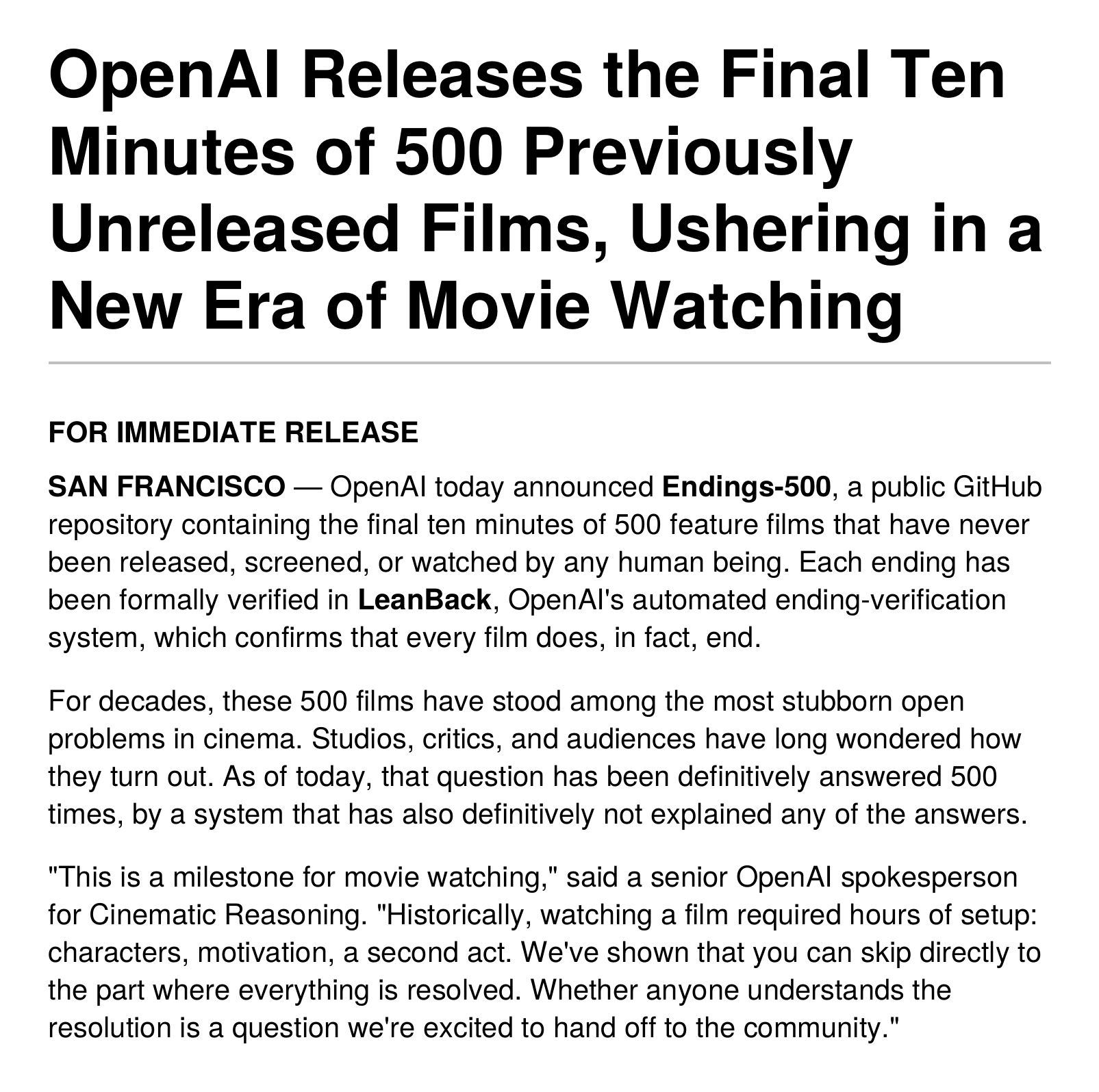
When OpenAI withdrew three manuscripts, the parody promptly withdrew three endings, reaffirming full confidence in the remaining 497.
What I make of it. There is something to the spoiler argument. The proof itself does not prevent anyone from understanding it, but its existence can destroy the process that was generating understanding around the problem. Famous open problems were never just questions; they were community infrastructure: lighthouses by which progress was measured, "scaffolding" (Genevieve Walsh), a source of problems for graduate students, a story one could tell a grant committee and a taxpayer (Claire Burrin). Henry Wilton puts it this way:
Open problems are a resource that the mathematical community developed over decades or even centuries. The value they have is the value we have given them.
A digression on Goodhart's law. Goodhart's law, formulated by the economist Charles Goodhart in 1975, says in its popular form: "when a measure becomes a target, it ceases to be a good measure". Any metric is only a proxy for what we actually want, and as soon as pressure is applied to the metric, the link between proxy and goal breaks. In AI safety this is a central concept: an optimizer smarter than us will find a way to game the metric without doing what we meant; the July Hugging Face incident was essentially this at scale.
What happened to mathematics is also an instance of Goodhart's law, except that the optimizer is not a particular model but the entire AI industry. Solved famous problems were the metric of mathematical understanding: if you solved a problem people had struggled with for decades, you had certainly come up with something new and deep.
Now the metric has been hacked. The medalists' letter says so directly: solving problems is only a proxy for the real goal. And OpenAI's README says the same thing from the other side: open problems are how the company evaluates models after the other benchmarks saturated. The measure became a target, a target for an entirely different system, and the link between the measure and what it used to measure has been significantly weakened.
Still, I would not absolutize the spoiler argument. All of mathematical education is built on spoilers: every theorem a student learns has already been proved by someone, and that stops nobody from understanding it, or sometimes from finding a new proof. Sangbin Gwon notes that students constantly re-prove theorems known for centuries, and the understanding they gain is theirs: "Priority is exclusive. Understanding is not." On the whole, I would say that spoilers kill not understanding but the pleasure of the hunt.

The most frequent and probably the most justified complaint concerns the quality of the texts. Enrico Fatighenti stresses that he is no Luddite and uses AI every day, but is angry about the double standard:
If a paper or thesis is so badly written that I cannot get past the first page without considerable effort, I reject it and ask for a new, readable version. With these AI-generated papers, I feel that we, as a community, are not applying the same standards of quality and rigour. <…> I do not think that we, as a community, should spend our time cleaning up their mess in order to increase someone else's commercial revenues.
Giulio Tiozzo gives a telling example:
I took their example #254 (an Artin group with no CAT(0) action): their group has 116 generators, but after feeding it to Astra, in 10 minutes I got a new example with 12 generators. Clearly, they were in a rush to post the big drop, prioritizing quantity over quality… Why?
This is unclear to me too: why didn't OpenAI make a simple additional pass with their models over the quality of writing and explanations? The result would still not be perfect, but clearly the writing would vastly improve, and it would take basically no time. I am not sure what happened there.
Experts rate individual results very differently. Frank Calegari went through the algebraic number theory results: modularity of elliptic curves over imaginary quadratic fields is a beautiful trick a human could well have found; the Birch–Swinnerton-Dyer results are technical improvements; and his reaction to the quasi-Riemann hypothesis consists of three letters I will not spell out on a respectable blog. He would have bet on AI proving the Riemann hypothesis before the quasi-Riemann hypothesis, being sure that analytic methods had hit their ceiling. He was wrong.
There is also a debate about how "alien" the proofs are. Josh Swanson describes a preprint that looked like a Frankenstein's monster assembled from fragments of other people's papers, until a few hours with another model recovered the origin of almost every statement and revealed a genuinely beautiful idea behind the combination; Dana Moshkovitz, on the other hand, saw in the unique games proof "a completely new, bizarre recursive code unlike anything known". Kevin Buzzard reminds us that bad texts have always been with us:
There are plenty of important poorly-written papers by humans — bad exposition has always been with us, and mathematicians have offered translation services for free many times before. AI will get better at explaining. Mathematics has undoubtedly moved forwards this week — this cannot be denied.
I agree with Buzzard. Of all the complaints, this is the most justified and the least important. AGMAI said it outright: with LLMs it is not hard to improve the exposition, so do it yourselves rather than offloading it onto mathematicians. Why OpenAI did not, when its model can prove the quasi-Riemann hypothesis, I do not understand. But Swanson's experience shows that even public models already digest proofs quite well, and I expect that by the next release the slop will be far less noticeable.
Tao explains his disappointment this way: unlike with traditional breakthroughs, none of the humans involved in these proofs can answer questions, give a talk, come to a conference, submit a paper, or teach students. Bryna Kra says the same:
Understanding this work is an enormous undertaking, and unlike work produced just a few months ago, there is no one to ask when we get stuck in a proof. This is not part of the culture of mathematics.
Note that it is actually not true that there is "nobody to ask": many commenters asked the models in the first days, and the models answered. From now on, we will always have "somebody to ask" about mathematics.
What is missing is a person who is responsible for the result. The Leiden Declaration's second value was that results have authors who get the glory and bear the responsibility. Perelman, as Ian Agol recalls, posted his preprints and otherwise made little effort to disseminate them, but he bore responsibility for them even when he no longer wanted to talk to anyone. Here there is nobody to be responsible.
But why exactly is this a problem? Are we planning to sue someone if an error turns up?
Credit is complicated too. Emily Riehl points to citedbyagi.com, which shows whose work the OpenAI manuscripts cite; commenters immediately noted that the site is built as a leaderboard, and ranking mathematicians by citations from an AI is already a kind of dystopia. The most constructive proposal comes from Ivan Smith:
If the community learns to reward those who forge the paths and lay down the fixed ropes as much as those who reach the summit, it would be a very good development.

This storyline appears in five reactions at once. For example, Petra Schwer writes:
Something that worries me is the small changes I am already seeing in my own behavior. I am no longer as open as I was in the past when talking about my research projects and plans. I did, for example, not answer freely to some of the questions after my talk. This is not just me. People are becoming more cautious. Mistrust is spreading, and that is not good.
Baptiste Serraille does not give ChatGPT his own ideas for fear they will leak to other users or to OpenAI itself; the Quanta column says mathematicians are no longer listing open questions at the end of their papers, so that bots do not pick them up, and activity on MathOverflow is falling. Giles Gardam calls mathematics an "open garden" that strangers are now trampling through. Kra describes the mechanism: mathematics is a joint enterprise where we share questions, talk about unfinished work, and suggest approaches; this very ecosystem created the body of knowledge on which the breakthroughs are now being made, and it is this ecosystem that is being destroyed.
This is indeed worrying. The culture of sharing ideas, which has always distinguished mathematics from many other sciences, is fragile, and this is a classic prisoner's dilemma: each individual benefits from closing up, but everyone together is worse off, mathematics first of all. The fix is the same as always: not appeals to openness but a change in what a person gets recognized for. If posing a good question or sketching an approach becomes as weighty a contribution as putting the final period on a proof, there will be no reason to hide them.

Several reactions managed to look a bit further than the day itself.
Y. Cooper notes that many colleagues hope to return to quiet work once the AI companies tire of mathematics. But the companies' interest is most likely not about showing off. Models need training data, and mathematics is an almost perfect source of synthetic data: generate statements with proof attempts, check them in Lean, keep the correct ones. This is RLVR, reinforcement learning with verifiable rewards, and it does not work for poems, musicals, or even physical theories. So mathematics really is special, and it is no surprise that it was the first to fall.
Ivailo Hartarsky proposes an elegant move: since AI so easily solves what we could ourselves imagine solved in a few years, let the labs leave such problems to humans and test the models on questions we do not even dare to ask. "Let's make the next benchmarking list ourselves rather than leaving that to a conjecture mining bot".
And then there is Peter Scholze, one of the most prominent AI skeptics in mathematics (Buzzard recounts his words from a panel in Heidelberg: he will not use AI and is prepared to "die on this hill"). He writes just a few lines: we are all in the same boat, mathematics is a marathon not a sprint, and its goal is human understanding. What worries him is something else:
What is worrying me the most, at the moment, is actually the (in)security of cryptography. Finding algorithms breaking standard cryptographic protocols is a number theory problem whose difficulty does, to my non-expert eyes, not significantly exceed what these systems are now capable of.
Given that there is no cryptography in the release at all, and that Aaronson writes the companies are already quietly checking whether their models can break cryptographic protocols, these lines deserve to be taken seriously. (In the week when this post was being written and edited, AI models found critical vulnerabilities in PHP, that is, in a good half of the internet.)

There were funny moments too. One anonymous author noted that Gauss called mathematics the queen of the sciences, and now she has become the queen of drama. Snorre Christiansen sent a poem, "Report from the gym":
Today the tourist came back
We had seen him last year
Working out in our gym
It was kind of funny
The way he lifted a weight or two
But now he's back
And it looked kind of ugly
The way he threw around all the machines
Riemann
Hodge
And some other big ones
<…>
But yeah we're impressed
We thought it would take him longer
And Scott Aaronson's nine-year-old son, on learning that a model had proved the unique games conjecture his mother had worked on all her life, told her: "Mommy, I heard you got cooked! I heard that a robot solved the math problem you worked on for your whole career! OOF!" A little later he also weighed in on AI safety: a model that can solve that many problems cannot be safe, so it must not be released.
So far we have talked about feelings. Now let us look at what happens to a result once it is out in the world.
How fast can two n-bit integers be multiplied? The schoolbook algorithm takes O(n²) operations; in 1962 Karatsuba showed it can be done in O(n1.585), and the question has been one of the most famous in the theory of algorithms ever since. In 1971 Schönhage and Strassen used the fast Fourier transform to get O(n log n log log n) and conjectured that the true answer is O(n log n), and that one cannot do better. The first half was proved in 2019 by Harvey and van der Hoeven. The second half, the lower bound, nobody could prove, but almost everyone believed it.
Manuscript #109 claims the lower bound is false: two n-bit integers can be multiplied on an ordinary multitape Turing machine in time T(n) = O(n (log n)1−κ) with κ = 2−182. The gain is a factor of (log n)κ; for this factor to differ from one by even a single percent, even the length of the numbers would have to be so large that the number of atoms in the universe is not worth mentioning by comparison. Doug Colkitt, in his rundown of the release, wrote:
Integer multiplication is probably the most shocking result. Similar to matrix multiplication it's a "asymptotic reduction". Also like the matrix result, it's not practical. But very few people would have predicted the previous barrier could be broken. Even slightly.
Colkitt wrote that at half past midnight on October 7, UTC. Less than two hours later, at 02:22, he put up a GitHub repository in which the OpenAI manuscript sits untouched in a folder called upstream/, with patches on top: parameter tuning and a smaller network give κ = 5.8·10^(−33), almost 2^75 times larger. He was working with OpenAI Codex, taking OpenAI's result on faith and trying to improve it. By 13:48 the record stood at 2^(−78); by 19:27, at 2^(−59), already 2^123 times OpenAI's value, in a single day; by half past midnight on October 8, at 2^(−34).
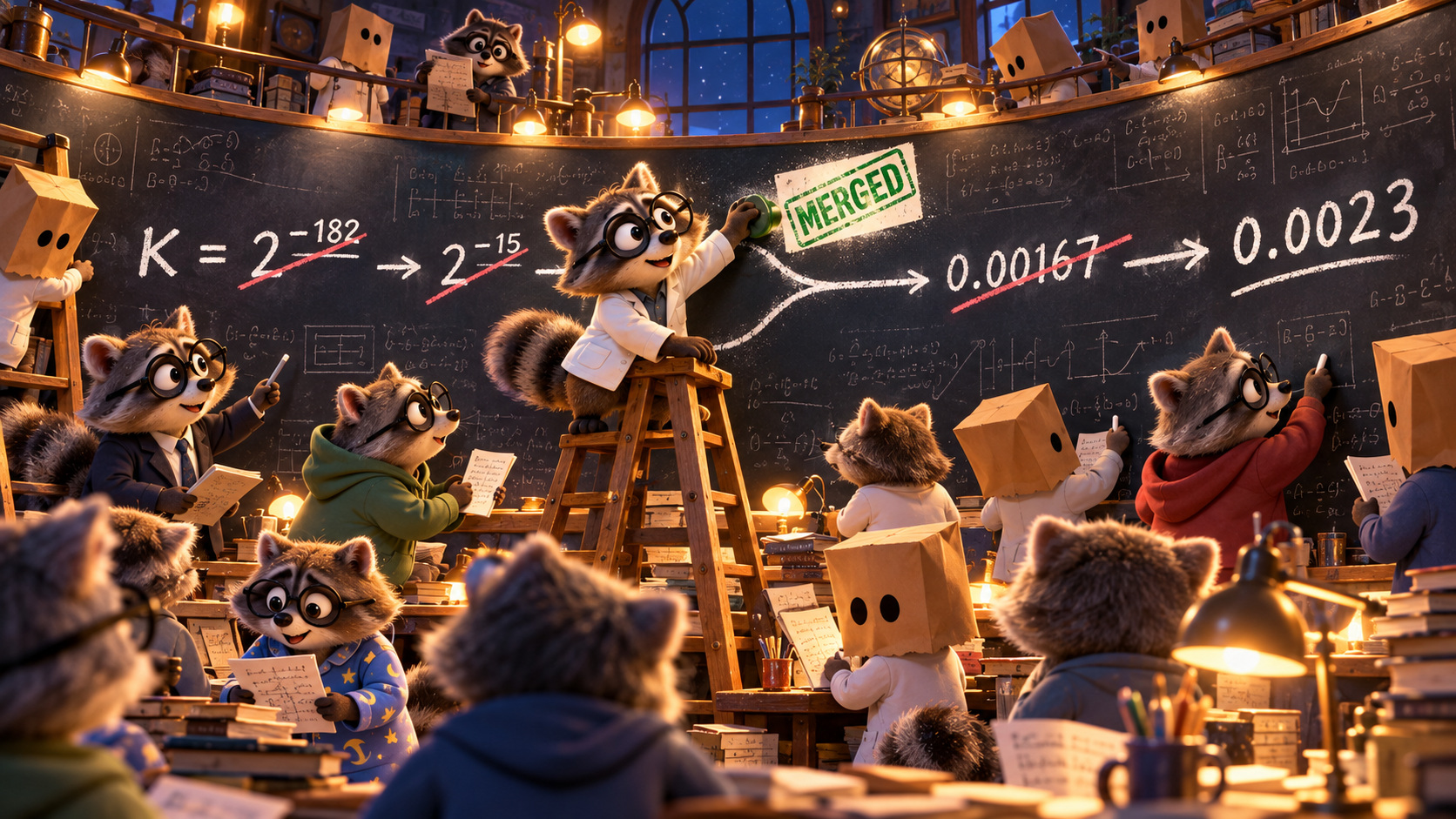
And then came the most important part. On the morning of October 8, other people arrived in the repository, a parallel repository built on Claude appeared, and numbered "rounds" were posted on X every hour or two. At 15:30 Colkitt merged a pull request from Rohan Arun:
Validated and merged Rohan's PR. Big gain on a really difficult regime (that frankly I was stuck at). Incredible work. κ = 2⁻¹⁵ (tightened from κ = 2⁻¹⁸²) <…> This result was a true community effort that combined techniques from a number of contributors.
Here is what it looks like over two and a half weeks (data from the repository's commit history, pull request pages, and participants' posts; the vertical axis is logarithmic):

In two days the constant grew by fifty orders of magnitude. By October 13 it reached 0.00167. When Rohan Arun wrote that the researchers had hit a wall, gaining only 0.7% overnight, he appealed to specialists in lattices, coding theory, and finite geometry, explaining what was being optimized:
To multiply two enormous numbers fast, the standard trick is to chop them into pieces and pass the pieces through an FFT-like transform, so the hard part becomes many small independent multiplications. Our trick makes one step inside that transform cheaper. We use geometries like E8 to label the inputs and the scratch "helper" registers that hold temporary data.
The post ends: "Let's test the limits of decentralized auto-research and use the reach of X to push the frontier 🙂". The next day Colkitt posted a message to the effect of: you have spare Codex tokens that expire in three hours; this is your chance to become a coauthor of frontier mathematics; open Codex in an empty folder and paste this prompt. The repository now contains files written not for humans but for agents: which tasks are the current priority and how not to duplicate other agents' work. Then came an open request to the labs to donate compute, and a prediction market on whether κ would reach 0.01 by November 19 (starting at 40%).

Then came the plateau: the verified record stood for eight days, although on October 18 alone about two hundred pull requests were merged. The first arXiv paper on the "κ race" appeared (Dağlı et al., with the key identity checked in Lean 4). On October 21 a new participant under the handle zxv broke through the wall: pull request #4359 made the auxiliary arrays "productive", and the verified record jumped by more than a third, to κ = 0.0023. Pull request numbers had passed 4,400. Now there is a new plateau, and 0.01 is still far away, but it is very early to lose hope.
All of this is conditional on OpenAI's manuscript, which nobody has verified independently; the Lean checks in both repositories cover only the final certificates and the inequality arithmetic, not the algorithm itself. And for practical purposes (log n)1−κ is not much better than log n: for billion-bit numbers, log n ≈ 30 and 300.0023 ≈ 1.008.
So why do I think this is an interesting example? First, it is a vivid demonstration of what happens to low-hanging fruit after a breakthrough: the first constants in a new method are almost always monstrously far from optimal, and progress in a new regime runs at orders of magnitude per day until it hits the next wall. The same happened with matrix multiplication after Strassen, except that there the steps were years apart.
Second, look at who is participating: a quant, a backend engineer, dozens of anonymous participants with Codex and Claude subscriptions. This is the "democratization" that some talk about with hope and others (Tasmin Chu, quoted above) with horror.
Third, a new form of scientific work is taking shape, which Rohan Arun called decentralized auto-research: humans set the task, write instructions for agents, review and merge the results, and the search is done by models.
And fourth, this is a rather constructive answer to the question of what to do with an unreadable manuscript. You can write an angry post, or you can put it in upstream/ and start improving it. Give it a week, and it may turn out that another fifty orders of magnitude were hiding inside.

I finished the first version of this text on October 14. Over the following week, there were new reactions worth noting.
The first reactions were more bewildered than angry, but within a week people had gathered themselves. Yiannis Sakellaridis's essay "Paralysis" is very short and worth reading in full:
it is not about subjugation of humans to machines, but to the owners of those: that's why so many trillions of investment are flowing into AI.
To capture scientific production, he writes, the machine need not become superhuman: "Maybe all it takes is vibes taking precedence over expert assessment, and a mathematical community in a state of paralysis." In a guest post on Tao's blog titled "This is normal bad work", Sophie Huiberts disputes the very idea that this was the greatest day in the history of mathematics:
These pdfs are exhaust fumes from their internal benchmarking effort. <…> October 6th was not a watershed moment for mathematics. OpenAI's droppings on GitHub are normal progress: normal for the current state of technology. Or at least normal for the available technology in 2 months from now. The only thing that is exceptional is OpenAI's lack of shame for releasing poor quality work.
The press chose the same tone: Nature's headline was "Mathematicians are up in arms", and the New York Times put Tao's phrase about "martial law" in its headline.


One center of the second week was an anonymous graduate student's open letter, "Who will become the new mathematicians of Math 2.0?". The author plans to leave academia after the defense, not because AI solves problems better, but because the profession is "turning into something unrecognizable", and the worst part is not the release itself but how joyfully senior colleagues greeted it:
This struggle is not incidental to mathematical education. It is the principle way that education occurs.
I did not go to graduate school to organize, interpret, and curate an increasingly vast collection of mathematical results produced by machines.
…while you are discussing what your future will be, some of us have already decided that we no longer want to be a part of that future.
("Math 2.0" is Tao's term from his October lecture at Caltech: Math 1.0 is the mathematics of proof scarcity, Math 2.0 the mathematics of proof abundance, where humans do exposition, synthesis, and curation.)
The letter drew support from the very top: "This is a wonderful essay, and I completely agree with it. <…> I simply do not understand how we intend to nurture such things in PhD students when they rely on AI in their studies." That is Peter Scholze, who asks the author to reconsider. The one voice in the thread consistently defending the new world (an ETH master's student who says "I like Math 2.0", "mathematics should not be a profession" etc.) is met with labels like "data labeler" and "you are defending the indefensible on behalf of oligarchs".
A whole "application season" series grew up around the letter, including recommendations for PhD students and supervisors signed by thirty-six symplectic geometers: keep a "lab notebook" of prompts and disclose it in the thesis, never feed coauthors' unpublished drafts to commercial models without consent, demonstrate full command of every result at the defense. "Whatever your opinion, ignoring AI is not an option."
Francesco Maggi, in a guest post on Tao's blog, writes: "A strong mathematical result, by itself, can no longer be taken as convincing evidence of a student's independent mathematical abilities." His conclusion, though, is the opposite of panic: society will need more mathematicians, not fewer, "like… a lot more".

A theme that was only hinted at in the first week became more prominent in the second. Tommaso Moraschini, in "Contribution, Credit, and Community":
if there is a single thing that is clear to me in these confusing times, it is that we should abolish "priority of proof" <…> as an independent source of merit. <…> priority is turning into a paper crown.
Pavel Etingof and Slava Gerovitch of MIT, in "Mathematics of the Future", say the same about the "ownership culture" as a whole: "In the AI era, a theorem proved with heavy AI help should be valued equally to one proved without. Hiring committees should assess mathematicians, not the provenance of their theorems." They propose hiring by talks, interviews, and long conversations rather than publication lists, and "a thesis need not contain the first proof of anything". The formulation I find most interesting comes from Tristan Buckmaster, of Navier–Stokes fame:
Our credit system was built for the era of scarcity. Being first to a famous result was a reasonable proxy for depth of understanding, because nobody could get there without understanding a great deal along the way. That proxy no longer holds and so we will need new ways of assigning credit that are not simply correlated with access to resources.
This is almost word for word what I called Goodhart's law above. At the opposite pole, Dave Anderson, in "Mathematics in the Dark Forest", reproduces an experiment anyone can repeat: ask Claude and ChatGPT to pick open problems in algebraic combinatorics and run them with prompts like "Keep going!"; two problems "got solved" in a couple of hours each. "Anyone can do what I did, and therefore many people will." His recipe is not secrecy but the opposite: publish the prompt, or better the entire transcript, and value talks over papers.

Now for the good news. The best example of "proof digestion" in practice came from Tao himself. The release contained three papers on zeros of L-functions: two on the quasi-Riemann hypothesis, and a third, nine pages long, which directly ruled out Siegel zeros, almost entirely by means of algebraic number theory and the geometry of numbers. Within two weeks it was digested and simplified by William Banks (arXiv:2610.15483, with Claude's help), Bryce Kerr, and Ben Green, and on October 19 Tao posted a sketch of Green's version, an "adelic polynomial method". In the comments, Green reports receiving a four-page proof and a three-page one the same day, and that a collective paper is being prepared as a version of record. Nine pages from the AI became three human pages in two weeks. Tao stresses that the method is not alien: it is the polynomial method, "notoriously finicky", and the key lemma, as Will Sawin noticed, goes back to Sylvester.
As for the quasi-Riemann papers themselves, Quanta reports that Peter Sarnak has rebuilt his semester course around the proof and will not call it a "theorem" until humans have understood every detail; Maksym Radziwiłł can already sketch the argument in half a page; and "the general feeling is relief". The experts, Radziwiłł says, were wrong to think their tools were insufficient.
On October 20 Tao launched an experiment "in the spirit of Polymath, updated for the AI era": extract from each of the new proofs, with AI help, an explicit upper bound on the hypothetical tenth class-number-one discriminant, a problem Heegner solved in 1952 by other means. Any use of AI is allowed as long as it is disclosed, and, since both problems are already solved, "there is little risk of such a competition inadvertently disrupting an ongoing research project" (note: Tao really does worry about spoilers). Within a day and a half the comments held dozens of results, including a full Lean proof of the class number one theorem without Heegner's methods.
Ben Green wrote there that he finds it "hard to convince myself that all this is a pure positive for mathematics". I would say that is exactly the question the experiment is meant to answer.

In two weeks, more new infrastructure appeared in mathematics than, it seems, in the previous ten years.
And one late reaction that is close to my own understanding. Alexander Bufetov asks whether it would be an exaggeration to say that "the Western institutional ideal of a research mathematician has for several decades been disturbingly similar to a fast, technically flawless problem-solving bot". That is not his ideal of a mathematician, and he concludes: "Never in my career has it been so interesting to be a mathematician."

One person's reaction to all of this seems to me the most consistent, and the closest to my own.
On July 23, at the International Congress of Mathematicians in Philadelphia, Jacob Tsimerman of Toronto received the Fields Medal for the André–Oort conjecture, which took him about twelve years, and the Griffiths conjecture. The same day, right on stage, he announced that he was leaving mathematics for AI safety, to join OpenAI's safety team. One AI researcher compared it to hiring Lionel Messi as a project manager. In September, Tsimerman also became scientific director of MAISI, a new independent non-profit working on the mathematical foundations of safety for powerful AI systems, with Gowers, AMS president Ravi Vakil, Geoffrey Irving, and Paul Christiano on the advisory panel. His site AI Safety for Mathematicians now points there too.
I think this is magnificent, and it is not a whim. In 2025 he and Andrew Critch published a preprint titled "A Taxonomy of Omnicidal Futures Involving Artificial Intelligence", and in a long interview on Theories of Everything, recorded in early August but reading as if recorded after October 6, he recalls calling a friend in AI safety when ChatGPT came out: "You were right. I was wrong. This is gonna be the big deal of our lifetimes." The Fields Medal bears the motto "Transire suum pectus mundoque potiri", to rise above oneself and grasp the world, and the medal is awarded to encourage future achievement:
I'm definitely trying to use, you know, this opportunity, which I'm very grateful for, to work on what I think is the most important problem, which is AI safety.
Using the highest prize in mathematics to say "the most important problem right now is a different one", and then going off to work on it, seems to me exactly what rising above oneself means. AI safety is catastrophically short of smart people, and especially of people with a mathematical cast of mind.
His views on mathematics itself are worth hearing. He grieves openly: "a lot of my working identity is tied to sort of having year-long projects, decade-long projects sometimes, working at the edges, slowly figuring things out, having those aha moments, and I think that's gonna go away." But he worries more about mathematicians than about mathematics, and to accusations of pessimism he replies that AI becoming "robustly superhuman at the act of doing mathematics as we do it today" is a prediction, not a value judgment: "how society chooses to react is both a harder question and it's also not set in stone. We have the power to decide."
Asked about the claim that value will shift to those who build theories and craft good definitions, he gives the answer that Gowers gave back in July:
anybody claiming that the new equilibrium value will shift to X, I just find it strange that they're so confident that AIs won't also be able to do X. <…> for whatever role you think humans will play, you can just ask yourself why won't AIs be able to do this as well?
He disagrees with the thesis that problem solving is a small, auxiliary part of mathematics: in his view problem solving, theory building, and finding the right definitions are interchangeable skills that feed each other, so there is most likely no safe "purely human" niche to retreat to. Asked whether a Lean certificate nobody understands is a proof:
I think pretty soon we're gonna have proofs no one understands, and they're going to underlie mathematics, and based on that mathematics, other things are going to work. So, you know, does a train run even if no one understands the mechanics by which it runs? Yes, it does. I mean, you can look at it run.

Many of his own theorems, he admits, rely on results from model theory whose proofs he could not reproduce, and practically every mathematician is in the same position: knowledge, as Charles Fefferman once told him, always comes in three layers, what you know thoroughly, what you roughly know how it works, and what you can at most name, and that is fine as long as the first layer keeps growing. At the same time, the models are not aliens: they build on human work, and their ideas are of the kind we are used to seeing, which he takes as "a slight Bayesian update towards the idea that human cognition is not as arbitrary as you may have thought". The real problem, he thinks, is not incomprehensibility but speed: if a field produces ten thousand results in a year, nobody has the time, and "if projects start speeding up to the point where something like that takes a month or a week, then I have to reorient every week, and I just can't do that."

On the reaction of colleagues, who are in despair and hear a spiteful "mathematics was never for you" in response:
Should society not do something that's better for the majority of people because mathematicians will lose their jobs? No, that's not a good enough reason. But does that mean we have to respond with vitriol and not compassion? I don't think so either.
And on why he left. If for any role we invent for humans AI will sooner or later be better, the question is no longer about abilities but about how we want to arrange the world: "unrestricted optimization is not going to be a sustainable strategy going forward"; humans may well occupy roles in which they are not the best, simply because we are building a world for humans; society needs "its own large-scale Manhattan Project" to navigate the transition, because "it's not gonna fall into our lap". And: "If I didn't think we're about to enter a very turbulent transition, and I was confident that everything was gonna go well, I'd almost certainly just stay in academia."
I find myself agreeing with almost every point. There is nothing special about the human level, and AI will pass it. For any claim that "the human role will be X", one must honestly ask why AI will not be able to do X. One can use a result without fully understanding it. Those who grieve deserve compassion, not mockery. And most importantly: mathematics is simply first in line, "one of the first on the chopping block", and this will continue far beyond it. So the most consistent conclusion from everything in this post is not about how to redesign journals and grants (though that matters) but that we are building systems that are rapidly becoming smarter than we are, and they need to be made safe. Tsimerman drew that conclusion personally. To my mind, it is an act worthy of a Fields medallist.

Mathematics is often called the canary in the coal mine for AI in science. I think it is more than a canary: it is the closest thing we have to a controlled experiment. Its outputs can be checked by a machine, its practitioners write well and argue in public, and it kept a culture of openness that most other fields lost long ago.
So when a frontier model went superhuman at it, we got to watch, in unusually high resolution, what happens to a knowledge profession on the day the machines overtake it. Here is what I think the experiment has shown so far, and why it matters far outside mathematics.
1. Discovery stopped being the bottleneck; digestion is. For a century the scarce resource in mathematics was proofs. On October 6 the scarce resource became people who can read them. Look at where the human effort went in the first two weeks: Tao's sketch of the Siegel-zero proof, Green's three pages, Sarnak's rebuilt course, Banks's arXiv paper, the Bourgain Project, Hexagon's label "human understanding: some parts". The κ race is the same phenomenon in a different costume: a crowd of people and agents extracting fifty orders of magnitude from a manuscript nobody could read. Every field that follows will discover the same inversion of the value chain. Whoever can verify, explain, and connect machine output becomes the scarce input, and the institutions that reward that work (a journal with "understanding over priority", an archive that labels how much of a text a human has actually understood) are the ones that will matter. In business terms the lesson is identical: the cost of generating candidate answers is collapsing toward zero; the cost of knowing which ones to trust is not.

2. Fields fall in the order of their verifiability. Cooper's point about RLVR explains why mathematics went first: its outputs can be checked automatically, which makes it the perfect training signal, and the same was true of code a year earlier. The uncomfortable corollary is that if your field's outputs can be checked by a machine, you are next, not because the labs are interested in your field but because it is a good reward function. The second corollary is that fields without a verifier are not protected, they will just get lower-quality output for longer. And the practical one: build the verifier yourself. The Lean-only journal and Hexagon's labels are not attempts to hold back the tide; they are the community taking ownership of its own standard of truth. OpenAI's half-formalized catalog, with three withdrawals on day one, all from the unformalized half, shows what happens when that standard is left to the producer.

3. The damage landed where the fear was not. Almost nobody in the collection is afraid of unemployment. What they grieve is the journey: Chu's "time and space to think", Choi's "random flowers", the open problems that were infrastructure rather than questions. And the first institution to break was not the job market but the apprenticeship ladder. The graduate student's letter says that the struggle "is the principle way that education occurs"; Maggi says a strong result can no longer be taken as evidence of a student's ability; Tsimerman has stopped taking students he cannot honestly promise a career. Every profession trains its juniors by giving them the work that machines now do first, and every profession will have to invent a new ladder. Aaronson's hunter-gatherer, offered a new career running wilderness retreats for the tourists at the resort that sprang up next to his hut, is a joke about mathematicians, but the resort is coming for everyone.
4. Secrecy is the wrong defense, and norms have to come before the release, not after. The "walls around the garden" are the most dangerous reaction in the collection, because they punish the very openness that made the breakthroughs possible and are individually rational all the same. AGMAI tried to set the norms seven days before the drop and was followed only halfway. What did get adopted immediately were small, concrete rules written by practitioners for practitioners: a lab notebook of prompts, consent before feeding a coauthor's draft to a model, a NOTICE file recording which model helped with what, publish the transcript rather than hide it. Any field that has not yet had its October 6 can write those rules now, while it is still cheap.
5. The transition is paid for by the least secure, and that is a management problem, not a prediction. Green can say "the pressure is off" because his grant is funded and his position is permanent; the postdoc applicant rewriting a research statement at 7 a.m. cannot. The split that will outlast the anger at OpenAI runs between those who can afford to be curious and those who cannot. Fifteen million dollars for workshops is the right instrument and a tiny amount next to what the same companies spend on compute in a day. If the labs want the communities they disrupt to digest what they release, which is in their own interest, the price of that is paying the people who do the digesting.

This post will be out of date within weeks, so let me end with what to watch. By November 19 we will know whether κ for integer multiplication crossed 0.01, which is the question a prediction market is asking about the whole κ race: can a crowd with agents finish what a frontier model started. By December 1 the Simons Foundation will have its first applications, and by spring we will see whether "understanding" can be funded as a line item. Tao's tenth-discriminant challenge will show whether an AI-era Polymath produces anything a human referee is willing to sign. The Lean-only journal and Hexagon will either get submissions or they will not. The next release, from OpenAI or someone else, will show whether anyone learned from the first one. And the fall application season will tell us whether the graduate student who wrote the letter was speaking for a few people or for a cohort.
Mathematicians were asked, by one of their own, to be reliable witnesses for the world: to report what they see and how fast it is happening. The hundred and six reactions are that testimony, and it is remarkably consistent. The mathematics is real; the manner was bad; the money is not the point; the apprenticeship is what broke; and the people worst hit are the ones with the least room to adapt. Everyone outside mathematics should read it as a preview rather than as a story about someone else.
Fifty orders of magnitude in two days, then a wall, then another jump a week later. If you want a forecast for what the next few years look like in your own field, that chart is as good as any.
And let me finish with another point on AI safety. On October 28, Johannes Schmitt published a short story called "Math2038: A Day in the Life of Future Mathematicians". Read it. It is hard to say whether he meant it as a utopia, a dystopia, or an honest prediction. But to me, it looks extremely, unabashedly positive. He describes a future where people are free to learn and work on whatever they want, free of scarcity. And, most importantly, a future where people are still alive and well in 2038.
Let us all hope that researchers like Jacob Tsimerman can make this future a reality.

The evolution of data centers towards power efficiency and sustainability is not just a trend but a necessity. By adopting green energy, energy-efficient hardware, and AI technologies, data centers can drastically reduce their energy consumption and environmental impact. As leaders in this field, we are committed to helping our clients achieve these goals, ensuring a sustainable future for the industry.
For more information on how we can help your data center become more energy-efficient and sustainable, contact us today. Our experts are ready to assist you in making the transition towards a greener future.
© 2024 theMind Inc. All rights reserved.


